
General Plumbing Repair
Why Is Water Pressure Lower Upstairs Than Downstairs?
Learn the difference between normal elevation loss and pipe restrictions, plus what to check before scheduling service.
August 14, 2026
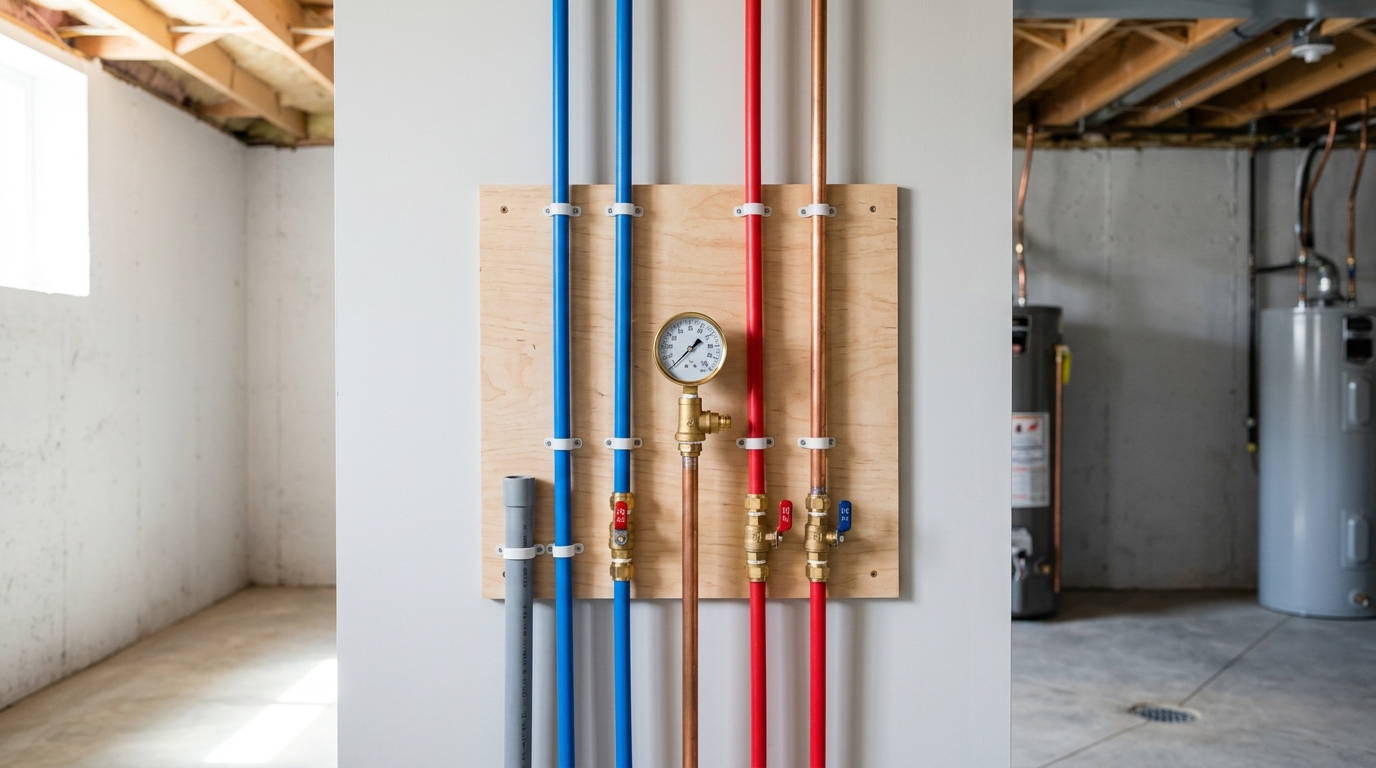
Why does my house have noticeably different water pressure on the first floor versus the second floor? When water travels up to your second story, gravity naturally pulls down against it, which causes a slight drop in pressure compared to the ground floor. However, if the difference between floors is drastic, frustrating, or getting worse over time, it usually means something is physically restricting the flow of water. Mineral scale inside older pipes, a partially closed shutoff valve, undersized branch lines, or a clogged fixture cartridge feeding the upper level can choke off water volume before it reaches your upstairs faucets.
Normal Elevation Loss vs. A System Restriction
In residential plumbing, gravity creates a predictable decrease in pressure as water moves upward. For every foot of vertical rise, water pressure drops by a little under half a pound per square inch (roughly 0.433 psi). In a standard two-story house with an eight-to-ten-foot ceiling, the expected loss between the main supply entrance on the ground floor and an upstairs showerhead is usually only about four to five psi. Under normal household conditions, that small difference is barely perceptible during everyday use.
If you step into your second-floor shower and feel an obvious trickle while the kitchen sink downstairs blasts water with strong force, something beyond simple physics is happening. A significant drop in performance usually indicates a restriction in either water volume (how many gallons per minute can pass through the pipe) or dynamic pressure (the pressure remaining while water is actively flowing).
Homeowner Checklist: What to Observe Around the House
Before assuming you need major work, walking through your home and noting specific patterns can help clarify where the problem originates. When our team inspects a home, having these details helps us zero in on the bottleneck much faster:
- Has this always happened, or is it a recent change? If your upper floor has felt weak since the day you moved in, the issue could be related to original pipe sizing, long routing runs, or an older municipal connection. If the pressure dropped suddenly over the past week, or has slowly dwindled over the past few months, that strongly points to developing sediment clogs, internal corrosion, or a failing mechanical component.
- Is it happening at every upstairs fixture or just one? Test the bathroom sink faucet, the bathtub spout, the showerhead, and the toilet fill valve on the second floor. If only the master shower suffers from low pressure, the culprit is likely a clogged showerhead filter screen or a worn balancing cartridge inside the shower valve. If every single faucet upstairs runs weak, the restriction sits further back on the main riser line supplying the upper level.
- Does upstairs pressure plummet when someone uses water downstairs? Turn on the kitchen sink or run a load of laundry on the first floor, then check the upstairs shower. If the upstairs flow drops to a faint stream only when ground-floor water is running, your main supply pipe or pressure-reducing valve may not be providing enough total volume to support multiple open fixtures at once.
- Is the issue present on both hot and cold lines? Turn the faucet entirely to cold, note the stream, and then switch entirely to hot. If the problem affects only hot water, the restriction may stem from sediment accumulation in the water heater, degraded flexible supply lines, or a clogged hot-water outlet nipple.
Why You Shouldn't Just Ignore a Worsening Pressure Gap
It is easy to dismiss weak upstairs flow as just an annoying quirk of living in a multi-story home, but an expanding pressure gap rarely fixes itself. Inside older copper or galvanized iron lines, hard water minerals and rust build up in layers, steadily shrinking the inside diameter of the pipe like a clogged artery. Left unchecked, this buildup strains plumbing joints and leaves fixtures starved for water.
A sudden shift in pressure can also indicate that an isolated shutoff valve has failed internally, a pressure-reducing valve (PRV) on your main service line has malfunctioned, or a small concealed leak is siphoning off water along the vertical run. Relying on guesswork can result in replacing perfectly good faucets when the true issue lies hidden inside your walls or basement.
How Professional Plumbing Evaluations Solve the Problem
Pinpointing why the upper floor is starved for water requires looking at your residential water distribution system as a connected whole. This is exactly what the general plumbing service from The Drain Man Plumbing is designed to evaluate. Rather than swapping out parts at random, a professional technician tests static and dynamic water pressure at several access points, inspects line sizing from the meter to the risers, checks for deteriorating pipe material, and verifies that regulator valves and distribution manifolds are balanced properly.
Whether your home needs line flushing, valve replacements, fixture maintenance, or updated supply pipe routing to handle your family's daily demand, a systematic inspection eliminates the guesswork and restores balanced, dependable water flow across every level of your house.
Get Balanced Water Pressure in Your Home
Tired of dealing with weak showers and slow-filling bathtubs on your second floor? The Drain Man Plumbing provides thorough residential plumbing evaluations throughout Jefferson City, Tennessee, and nearby communities. Connect with our local team online through our website contact form or give our office a direct call to set up a comprehensive plumbing assessment for your home.