
Sink Repair
Why Cold Water Leaks When You Turn on the Hot Faucet
Learn why hot and cold water cross paths inside your faucet and how a proper cartridge repair fixes the problem.
August 19, 2026
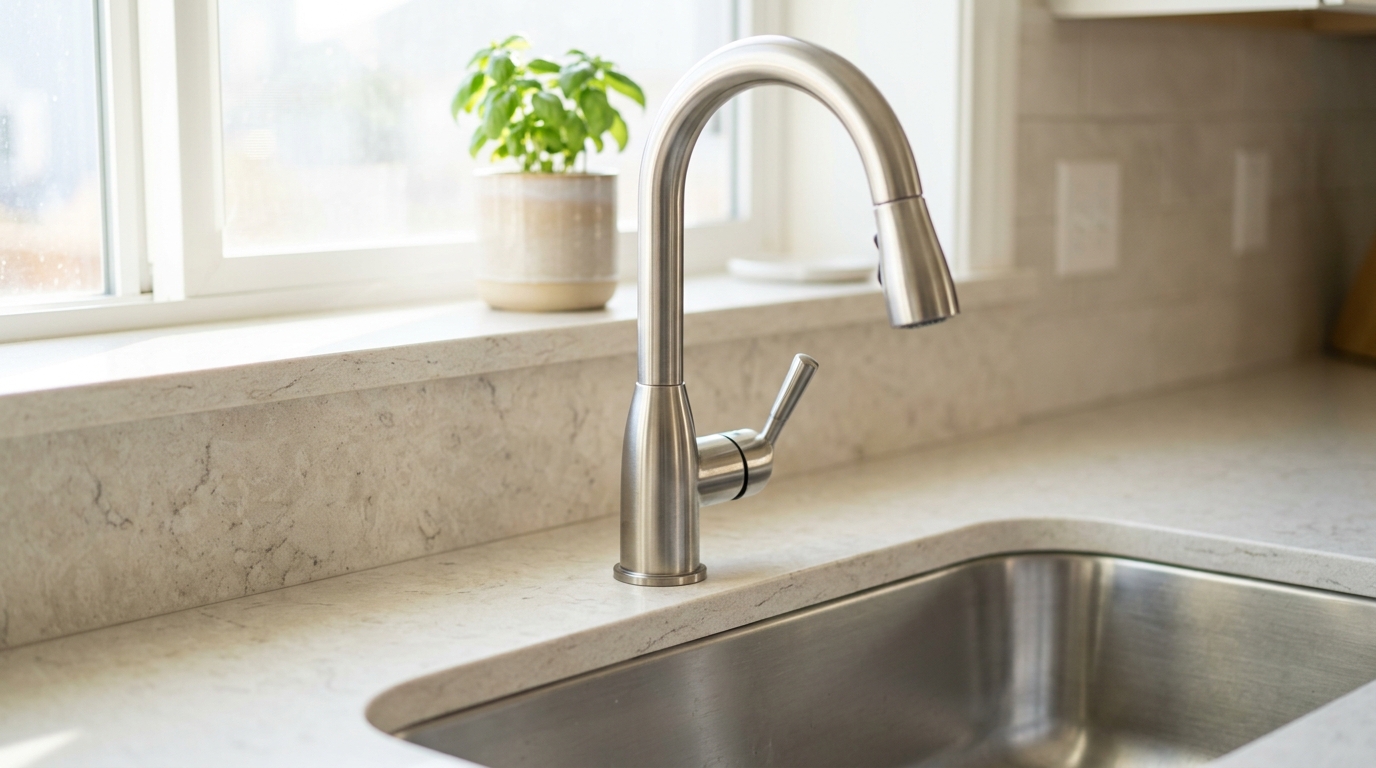
Why does cold water leak from my kitchen faucet even when I only turn on the hot side? Inside your kitchen faucet, there is a small part called a cartridge or valve that is supposed to keep your hot water and cold water separate. As you use your faucet day after day, the small seals and internal parts of that cartridge wear out. When those parts break down, cold water can sneak past the barrier and cross over into the hot side, leaving you with lukewarm water, strange drips, or unwanted leaks around the spout and handle.
Understanding How Single-Handle Kitchen Faucets Work
Most modern kitchen sinks use a single-handle faucet to control both water flow and temperature. Underneath the decorative metal handle sits a compact mechanical piece known as the faucet cartridge. This piece connects directly to two incoming water supply lines: the hot water line coming from your water heater and the cold water line coming from your main water supply.
When you pivot the handle toward the hot position, internal channels inside the cartridge slide into place. In a healthy faucet, these channels open the hot water passage completely while sealing off the cold water passage entirely. When the internal rubber O-rings, springs, or ceramic discs inside the cartridge wear thin, crack, or accumulate mineral buildup, that seal fails. Cold water, which is under constant household line pressure, pushes past the worn seal and bleeds into the hot water chamber or seeps out around the fixture body.
What to Do in the Short Term
If you notice cold water entering the mix or leaking while running only the hot tap, you do not necessarily need to panic, but you should take a few practical steps to evaluate what is happening:
- Check the severity of the crossover: Turn the handle all the way to the hot position and let it run for a couple of minutes. Touch the water stream carefully to see if it reaches full temperature or remains lukewarm. A lukewarm stream confirms that cold water is continuously mixing in.
- Inspect for external drips: Look closely at the base of the faucet and around the handle collar while the water is running. Note whether water is pooling on top of the countertop or leaking down into the cabinet below.
- Monitor for changes: Pay attention to whether the problem is staying consistent or getting progressively worse. A slow drip can develop into a steady leak as the cartridge degrades further.
- Check the undersink shutoff valves: Open your sink base cabinet with a flashlight and make sure the hot and cold supply lines are fully turned on and dry to the touch. This helps confirm that the issue is isolated inside the faucet itself rather than in the supply connections beneath the sink.
The Challenge of Replacing a Faucet Cartridge
Homeowners often wonder if a leaking cartridge is a simple DIY fix. While the concept of swapping out a worn part sounds easy, the actual process requires precision and specific knowledge of plumbing hardware.
1. Identifying the Exact Replacement Part
There is no universal faucet cartridge. Hundreds of different cartridge designs exist across various manufacturers like Moen, Delta, Kohler, American Standard, and generic brands. Even within a single brand, different model years and faucet styles utilize distinct cartridge lengths, diameters, spline counts, and O-ring configurations. Installing a cartridge that looks nearly identical but differs by a fraction of a millimeter will result in persistent leaks, a loose handle, or completely blocked water flow.
2. Disassembly Without Damaging the Fixture
Removing the old cartridge requires taking off the handle, decorative cap, and retaining bonnet nut. In areas with hard water or mineral accumulation, these components often seize together over time. Applying too much force with standard pliers can strip the decorative finish, bend the copper internal tubes, or crack the faucet housing, turning a minor repair into a full faucet replacement.
3. Proper Alignment and Reassembly
Once the correct new cartridge is sourced, the internal cavity must be cleaned of sediment and mineral scale before installation. The new cartridge must be inserted in the exact correct orientation—installing it backward can reverse your hot and cold controls. The retaining nut must then be torqued properly: too loose, and water will blow past the O-rings; too tight, and the handle will be stiff or the new cartridge will crack.
How The Drain Man Plumbing Can Help
Because faucet cartridges require exact part matching and careful handling, this is a straightforward repair for an experienced technician who works with residential fixtures every day. Our sink repair service at The Drain Man Plumbing handles cartridge replacements, valve repairs, and faucet troubleshooting for homeowners throughout Jefferson City, Tennessee.
We inspect your kitchen fixture, identify the precise manufacturer specifications, safely remove the worn-out components, and reinstall the proper cartridge so your hot and cold lines stay completely separate once again.
Get Your Kitchen Faucet Fixed Today
If cold water is mixing into your hot water line or leaking around your kitchen faucet handle, let our local team take care of it. Contact The Drain Man Plumbing by calling our Jefferson City office or submitting a service request through our website to schedule your sink repair appointment today.